GARDENS BY THE BAY
PURPLE PERENNIALS & THEIR COMPANIONS - 1
What a rich range of colour the purple perennials add to a garden - violet, lavender, mauve, lilac, amethyst, magenta, royal or imperial purple, the fruity tones of plum, mulberry and grape and the bluish tones of gentian and indigo to mention a few.
Just close your eyes for a moment and picture some of the many other colours that would set off these purples to advantage - yellow, pink, white, orange, selected reds and other purples in flower colour, not to mention the grey, silver, silvery-grey or the many green shades of foliage.
* Watch for the animated hummingbird and butterfly with the plants that attract them. *
The deer icon indicates plants that deer are not usually attracted to.
   The best time and method to propagate plants can be found on our image-intensive PROPAGATION page.
To help your plants grow their best, check out our FERTILIZATION page.
To create your own plant partnerships based on tried and true color theory, check out our GARDEN COLOR page.
To see if a particular plant is on this page press Ctrl+F, type in the name, then click the Find button.
The best time and method to propagate plants can be found on our image-intensive PROPAGATION page.
To help your plants grow their best, check out our FERTILIZATION page.
To create your own plant partnerships based on tried and true color theory, check out our GARDEN COLOR page.
To see if a particular plant is on this page press Ctrl+F, type in the name, then click the Find button.
ACONITUM
 Lucky indeed is the gardener fortunate enough to have room to grow a large patch of these dark beauties. Although they are available in forms having blooms of pink or yellow, most have hooded flowers in the blue to purple range. Keep them in the rear of your borders, far away from young children or pets who might be tempted to eat their highly poisonous blooms.
Aconitum: violet forms
Lucky indeed is the gardener fortunate enough to have room to grow a large patch of these dark beauties. Although they are available in forms having blooms of pink or yellow, most have hooded flowers in the blue to purple range. Keep them in the rear of your borders, far away from young children or pets who might be tempted to eat their highly poisonous blooms.
Aconitum: violet forms
in front of: Filipendula rubra 'Venusta'
Aconitum: violet or blue & white
behind: Phlox paniculata (white) with three Hemerocallis, one yellow, one peach and one light orange, in front of all
beside: Monarda (red)
Aconitum: deep violet
behind: Phlox paniculata (white)
Aconitum carmichaelii wilsonii: rich violet-blue, 6', late bloomer
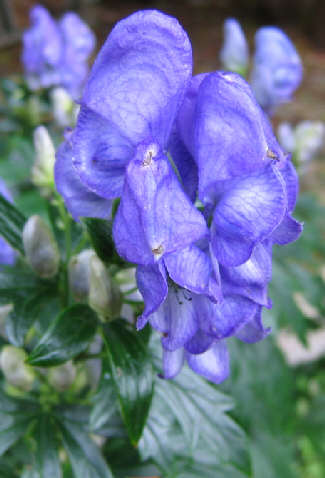
with: Cimicifuga 'White Pearl'
near: Anemone x hybrida
For more ideas and instructions on using Monkshood in the garden, check out the links below.
blue Monkshood
yellow Monkshood
ASTER
What better way to obtain bloom from early in the season to latest fall than with various members of the genus, Aster. The ultimate daisy - these range from the small and early Aster alpinus to the extremely tall and later-blooming New England and New York forms. The purplish tones range from violet-blue, powder blue, pale blue, lavender-blue, lilac, royal purple to deepest purple. They are also available in salmon-pink, pink, white, cerise, rose-pink, ruby red, sky-blue and nearly pure blue. Most asters have a yellow or gold center, although a few have a reddish one.
Aster alpinus: purple forms
in front of: Artemisia ludoviciana 'Valerie Finnis'
beside: Aster x frikartii (which will later provide a contrast to the same A. ludoviciana 'V. Finnis')
Aster 'Little Blue Boy': a dwarf form
beside: Sedum 'Autumn Joy'
Aster tataricus: Tatarian Aster, pale blue to lavender, tallest of all forms
where: back of border
with: Ornamental Grasses
You can find more combination ideas for other Aster species and cultivars by following any of the links below.
numerous Asters
blue Asters
pink Asters
Asters for shade
white Asters
AUBRIETA
For earliest spring color, what can compete with the wonderful purple tones of Rock Cress? Spilling over rock edges or walls, or carpeting a patch of sloping ground, these beauties are wonderful in themselves, but set off all those early-blooming spring perennials and bulbs to perfection. A quick haircut after their bloom has finished will freshen up the evergreen foliage and keep it looking good into fall and winter, when it often produces more sporadic bloom.
Aubrieta deltoidea: Rock Cress
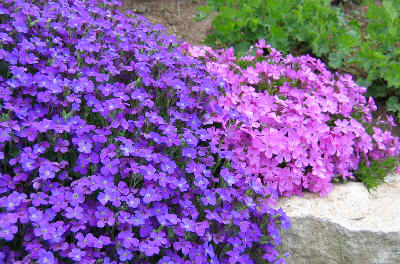
co-blooms with lovely pink Phlox subulata as seen above
excellent for: rock walls, spilling over rock ledges
also good with: species bulbs
You can find more information about growing Rock Cress as well as partnership ideas at the link below.
Aubrieta as edgers
CAMPANULA
Is there any group of perennials that produces more blooms than the variable genus, Campanula? If there is I haven’t found it yet. As anyone knows who has tried to count the spent blooms as they are being dead-headed, it is not unusual to reach numbers in the hundreds. When you tire of this calculation (you’ll probably only do it once or twice), you can reach for the shears and give the plant a quick, overall haircut back to below the blossoms and it won’t be long before another flush of flowers follows. Most forms are more subtle than they are big or blowsy, but to soften a grouping of plants in the garden, they have no equal.
Campanula: Bellflower, low varieties
with: Coreopsis verticillata, Iris sibirica, Astilbe, Geranium, Dianthus, Aquilegia
in shade with: Hosta & ferns
Campanula: Bellflower, taller varieties
with: Rosa (pink), Sedum 'Ruby Glow', Geranium psilostemon (a magenta eye-stopper)
mid-bed with: Gypsophila paniculata, Digitalis, Iris sibirica
Campanula x 'Birch Hybrid': a profuse bloomer, 4"x20"
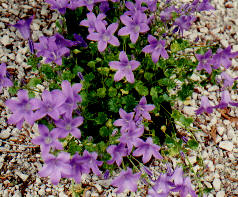
note: attracts hummingbirds
where: small crevices in rock gardens or walls, tubs, containers, in morning sun
with: blue Festuca or other small ornamental grasses
with: Coreopsis verticillata, especially ‘Moonbeam’
under: Lilium (Oriental or Asiatic)
with: Alcea rosea (hollyhock), Delphinium (Larkspur), Digitalis purpurea, hardy Geranium, Hemerocallis
with: Iris sibirica, Phlox subulata, Phlox paniculata
in light shade with: Alchemilla mollis, Astilbe, Heuchera
Campanula carpatica: Bellflower, Carpathian Harebell, purple forms
where: rock gardens, border edging plant
beside: Heuchera sanguinea, Oenothera missouriensis
between: Hosta sieboldiana 'Elegans' & Heuchera sanguinea
between: Veronica & Hosta plantaginea
Campanula carpatica 'Blue Clips': Bellflower, Carpathian Harebell
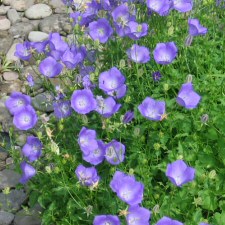
over: Crocus
under: wine-red lilies
between: Heuchera sanguinea & Salvia 'East Friesland'
offset behind: Coreopsis verticillata 'Moonbeam'
Campanula glomerata: Clustered Bellflower, deep purple or white, 12-18"
with: ferns, orangish-apricot tones i.e. Lychnis hybrids
Campanula glomerata 'Superba'
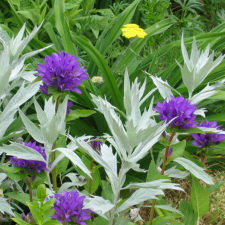
seen above with: silvery Artemisia 'Valerie Finnis' and yellow Achillea 'Moonshine'
where: in borders, shaded gardens
with: clashing but good combination for hardy Geranium (magenta), Iris sibirica, Doronicum orientale, ferns
behind: Dianthus (pink shades)
Campanula lactiflora: taller species
Note: these can also be white, blue or pink
with: Aruncus dioicus, Achillea, Gypsophila paniculata
Campanula lactiflora: lavender-blue
with: shrub roses
beside: Thalictrum aquilegiafolium
Campanula latifolia: Great Bellflower, taller species, purple-blue

with: Aruncus dioicus, Achillea, Gypsophila paniculata
Campanula persicifolia: Peach-Leaved Bellflower
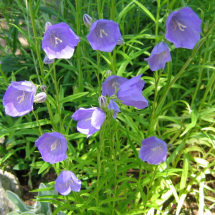
where: mid-border, with fine-textured plants, in drifts along stone wall or fence
behind: Geranium sanguineum
in front of: Delphinium
Campanula persicifolia: Peach-Leaved Bellflower, lavender-blue or white
in light shade with: Digitalis
in sun wedged between: Alchemilla mollis (in front) & old roses (behind)
Campanula persicifolia: Peach-Leaved Bellflower, especially purple tones
with: Achillea, Lupinus, Papaver orientale, Perovskia atriplicifolia
Campanula persicifolia 'Telham Beauty': lavender-blue Peach-Leaved Bellflower, 3'
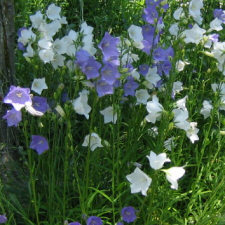
with: Campanula persicifolia (white forms)
combined with: Campanula persicifolia 'Grandiflora Alba', Digitalis ambigua, & Allium moly
Campanula portenschlagiana: Dalmatian Bellflower, a spreading ground cover, 4-6", lavender
over: Crocus chrysanthus, Crocus spp, Galanthus nivalis
with: yellow-leaved Hosta
with: drifts of Ajuga, Hosta, Vinca & other ground covers
Campanula portenschlagiana 'Resholt': violet Bellflower
where: part shade or full sun, sprawling over rocks or stone walls
The wonderful Bellflowers in their many forms can be used to good advantage in a garden. Check out the possibilities at the following links.
blue Bellflowers
pink Bellflowers
white Bellflowers
CATANANCHE
If you haven’t yet tried this wonderful perennial, do so in the near future. Floating on wiry stems, the light purplish flowers with a maroon eye have a crisp, papery feel. They can be used to good effect in drifts in the garden or are suitable for dry arrangements as well. My favourite companion is the Spanish Bluebell, or Wood Hyacinth, Hyacinthoides hispanica, formerly known as Endymion hispanicus, and sometimes called Scilla campanulata which blooms before Cupid’s Dart and benefits by the perennial’s growth to hide its own dying foliage and fill the space it leaves when it retreats underground.
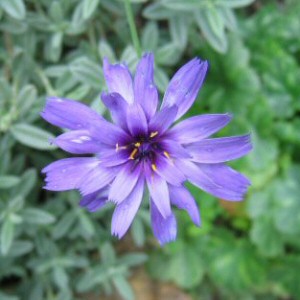
Catananche caerulea: Cupid's Dart, lilac-blue
this papery flower can be seen in the border around this page and directly above
where: in masses, in rock gardens, as frontal plant
with: Achillea, Artemisia stelleriana, Oenothera
offset beside: spring-flowering Endymion hispanicus (to hide dying foliage & fill empty space)
with: Anemone pulsatilla, Anemone sylvestris, Aquilegia, Dicentra
in light shade with: ferns, Helleborus orientalis, Hosta, Myosotis, Phlox divaricata, Phlox stolonifera, Primula
with shrubs: Chaenomeles japonica, Forsythia, Jasminum nudiflorum, Rhododendron, Deutzia gracilis, Weigela
with low-growing shrubs: Cotoneaster, Berberis
with bushy, tree-like: Acer palmatum
DELPHINIUM
An eye-catching, stately plant in its many hues, the delphinium clan even boasts some true-blue shades. If summers are cool, they perform at their best. Even when we can’t provide the ideal habitat, we can enjoy them for the brief time they grace our gardens and replace them when necessary so we won’t be long without the wonderful contribution they make to every garden picture.
Delphinium: violet
behind: Lilium regale (white) & Achillea (pinkish-lilac, cerise-red or buff yellow 'Great Expectations)
above combination behind: Sedum 'Dragon's Blood' (wine foliage & reddish-purple flowers)
Delphinium: dark violet
behind: Lilium (light yellow forms) and an edging of Alchemilla mollis
Try the links below for additional partnership ideas and information about growing the Delphinium to best advantage.
blue Delphiniums
white Delphiniums
HEMEROCALLIS
Though individual flowers last only one day, supposedly a well-established clump of daylilies can produce more than 300 flowers in a season, sometimes over a period of three to four weeks. If you choose cultivars from the early, mid and late bloom seasons, you can have nearly continuous blooms for three to four months. Below are only a few from the purple range, but there are thousands of others of nearly every hue imaginable.
Hemerocallis 'Bali Watercolor': lavender with silvery watermark above green throat, scape height 35", bloom 9"
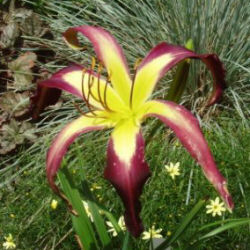
this Spider daylily was registered in 2002, Spider Ratio 4.36:1, season M, Fragrant, Rebloomer
Hemerocallis 'Black Ice': black self above yellow green throat, scape height 32", bloom 7.5"
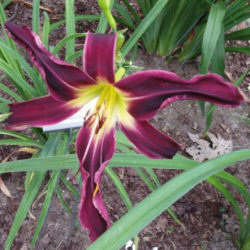
this Spider daylily cultivar was registered in 2000, Spider Ratio 4.13:1, season M
Hemerocallis 'Frankie's Fantasy': dark purple spider self with green throat, scape height 32", bloom 7"
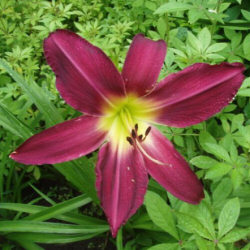
this Spider daylily cultivar was registered in 1992, Spider Ratio 4.50:1, season EM, Rebloomer
Hemerocallis 'Peacock Maiden': purple with creamy white eyezone & large green throat, scape height 31", bloom 9.5"

this Unusual Form Crispate daylily cultivar was registered in 1982, season M, Fragrant Rebloomer
Hemerocallis 'Thunder Mountain': purple self above yellow throat, scape height 34", bloom 7.5"
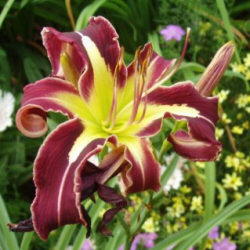
this Unusual Form Crispate daylily cultivar was registered in 2002, season M
Hemerocallis 'Lavender Tonic'
combined with: Lythrum virgatum ‘Morden Pink’ & Veronica longifolia 'Sunny Border Blue'
Hemerocallis 'Little Grapette': mauve
combined with: Echinacea 'Bright Star', pink Allium 'Summer Beauty' & yellow Coreopsis verticillata 'Moonbeam'
Hemerocallis 'Prairie Blue Eyes':
Hemerocallis 'Summer Wine': strong violet, 5-1/2" wide flowers
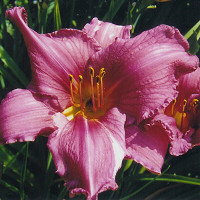
This cultivar is variously described as light wine-red, clear grape-violet, plum-wine, rose-wine, dusky maroon-red, strong violet and deep wine to quote just a few sources. If you use Google/Images to view pictures of it, you will see that cameras are no more able to capture the reality of the colour than the verbal descriptions are. So my advice would be - buy it, grow it and decide what colour it is yourself. However you describe it, it will make a wonderful addition to your garden and will surely complement anything in its vicinity. Trust me.
Hemerocallis 'Train to Venice':
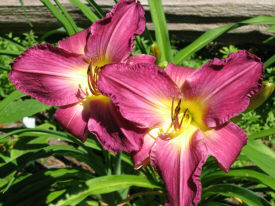
this huge-flowered beauty is so stunning it creates significant impact all by itself
A wealth of possibilities awaits. Use the ideas and information at the links below if you are planning to add more Daylilies to your gardens.
numerous Daylilies
orange Daylilies
pink Daylilies
red Daylilies
Spider and Unusual Form Daylilies
white Daylilies
yellow Daylilies
HESPERIS
A Phlox paniculata look-alike, Hesperis has similarly rounded flower clusters. However, while Garden Phlox blooms bear five petals, those of Dame's Rocket have only four. This fragrant native wildflower will bring beauty to any setting you can provide, from woodlands to full sun. Self-sown seedlings will keep this short-lived perennial around for years.
Hesperis matronalis: Sweet Rocket, Dame's Rocket: 2-3'x18-24"

where: borders, meadows, woodlands
with: Tulipa, Paeonia, Iris x germanica
to fill area during dormancy, with: Artemisia, Achillea
HEUCHERA
If you want plants with all-summer presence in the garden, you can do no better than to choose from this genus. While in bloom, the delicate flowers of Coralbells will delight, with their ability to sway in the slightest breeze on their erect stems. Blooms are sometimes inconspicuous, but the foliage is always of interest. The purple tones mentioned below refer, of course, to the foliage, rather than the flowers.
Heuchera 'Plum Pudding': pewter-grey foliage underlaid with deep purple, and pinkish flowers, 22"x12"
with: Heuchera 'Silver Veil'
Heuchera 'Silver Shadows': purple, metallic leaves, 26"x16"
with: lime-green Filipendula, deep blue Corydalis 'China Blue'
Heuchera micrantha 'Bressingham Bronze': improved 'Palace Purple', deepest purple of the type, off-white flowers, 24"x12"
with: Festuca ovina glauca
Heuchera micrantha 'Palace Purple': seed-grown strain, 18-24"x12"
where: best in part shade
with: pink, lavender, blue and white
amid: dwarf Iris cristata 'Alba'
in shade with: Lamium 'Beacon Silver', (blue) Hosta 'Halcyon', Dicentra eximia
in shade with: Pulmonaria saccharata, Nepeta 'Blue Wonder', Geranium 'Johnson's Blue'
with: Gypsophila paniculata, Artemisia 'Powis Castle', Oenothera missouriensis 'Green Court'
with: Liatris spicata, Sedum 'Vera Jameson'
in front of: Digitalis, Allium, Artemisia versicolor
Go to a large nursery and check out the plant tables where the Coral Bells reside to see just how many choices are available these days. Perennial flowers in a garden are fleeting but some of the forms at the links below can provide season-long interest with their wonderful foliage.
Coral Bells as edgers
pink Coral Bells
red Coral Bells
Coral Bells with silver foliage
white Coral Bells
Coral Bells to attract Hummingbirds
Coral Bells with variegated foliage
INCARVILLEA
Commonly known as Hardy Gloxinia, Incarvillea is, in fact, not particularly hardy, preferring winter protection north of Zone 5. And it is certainly not a Gloxinia. So what is the attraction with this rosy-purple perennial? It could be the large flowers, their trumpet shapes calling out for your attention. Or it might be the somewhat tropical look of the blooms, held above dark, bold, low-growing green leaves. Unless you have soil that is excessively moist, you might want to give this one a try.
Incarvillea delavayi: 18-24"x12"
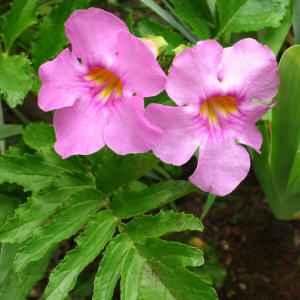
under: Eremurus
with groundcover plants: Arabis, Iberis, Sedum
in partial shade with: Asarum, foliage plants
IRIS
It is much harder to study and learn about all the different types of Irises than it is to grow them. Most do well in the average garden with little extra care beyond regular maintenance to keep them pest and disease free. And the colours! The flower form! The texture! A large clump will produce a stunning overall appearance while a single flower stalk in a vase for close-up viewing will amaze you with both its simplicity and its complexity.
Iris x germanica: tall deep purple
with: Cerastium tomentosum
Iris x germanica: dark violet
with: Geranium clarkei 'Kashmir White'
beside: Gypsophila repens 'Rosea'
Iris: purple dwarf bearded
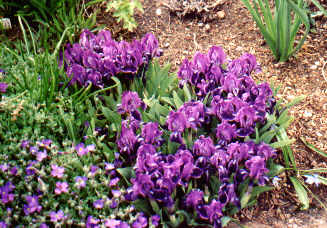
seen in the photograph above with purple Aubrieta and other emerging spring bulbs
Iris 'Batik': Border Bearded, royal purple, mottled white, 24"
Iris x germanica 'Black Flag': award winning Tall Bearded Iris, very deep violet

seen in the photo above with Miscanthus sinensis 'Silberpfeil', Scilla sibirica and buds of a nearby white peony I hoped would bloom with it
Iris 'Dusky Challenger': Dykes Medal '92, deepest purple, 40"
combined with: lemon-yellow Iris 'New Moon' & white Iris 'Ermine Robe'
Iris 'Edge of Winter': deep lavender standards, white falls with touch of pale blue, 37"
Iris x germanica 'Wabash':
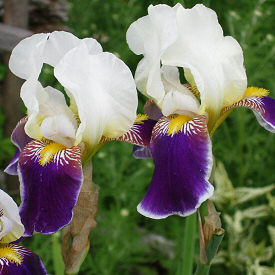
Is it predominantly purple or white?
with: Trollius to echo the yellow highlights of the beard
Many companions will contrast with either of the main colours.
Need inspiration? Read the partnership recommendations of gardening experts at the links below and create the combinations you need to give your garden some extra zip.
blue Iris
bulbous Iris forms
Iris as edgers
orange Iris
red Iris
white Iris
yellow Iris
Iris with variegated foliage
LAVANDULA
Everyone has surely seen photographs of huge drifts of this perennial herb whose common name reveals the color of its flower. Unless you are allergic to bees, you will want to try to re-create such a drift in your own flower beds, not only for the blooms produced but for the wonderful scent of the foliage as well.
Lavendula: Lavender
where: ornamental or herb gardens, rock gardens, as edger
with: Stachys byzantina or Thymus pseudolanuginosus (for textural contrast)
in rock gardens with: dwarf Achillea, Arabis, dry-soil plants
with: Verbena including V. bonariensis
in borders with: Eryngium, Echinops ritro, Achillea, Dianthus, Sedum, Oenothera, Hemerocallis, shrub roses
in front of: Tradescantia (to keep it from flopping forward))
with: roses (shrubs similar in colour to Lavandula or other pinkier shades)
with: low growing sun-loving types of Phlox
with: Scabiosa columbaria 'Pink Mist'
with: Yucca
with: Lilium martagon album, Lychnis (white Campion), Lythrum, Oenothera fruticosa, Oenothera speciosa 'Rosea'
More ideas, companions and information are waiting at the link below.
blue Lavender
Lavender with silver foliage
LIATRIS
The tall, feathery wands of densely-packed flower-heads of the Gayfeathers open from the top down. This alone makes them different from most other perennials. The grass-like foliage provides another point of interest in the gardens they grace. And the fact that they also serve as an attractant for birds and butterflies will make you crave them all the more.
Find the best companions and care information for this genus by following the links below.
many Liatris forms
white Liatris forms
FOR PURPLE PERENNIALS & THEIR COMPANIONS - 2 FOLLOW THE LINK BELOW.
All of our own Gardens By The Bay pages can be accessed by clicking on the links below.
HOME
GARDEN POETRY |
GARDEN POETRY MUSE
GEORGIAN BAY VIEW
BOTANICAL LATIN - BASICS
COLOR THEORY
THE GARDENS
CORNER GARDEN CONSTRUCTION |
CORNER GARDEN PLANTING |
LONG GARDEN
EAST GARDEN |
HOSTA GARDEN |
NORTH GARDEN |
WINTER GARDENS
PLANT PARTNERSHIPS
BLUE PERENNIALS Aconitum -
Geranium |
Iris - Vinca
BULBS Allium - Hyacinthus |
Narcissus only |
Tulipa only |
Minor Bulbs
BUTTERFLY MAGNETS Anaphalis - Hemerocallis |
Liatris - Veronicastrum
 DAYLILIES Spider & Unusual Form
EDGERS Arabis - Iris |
Nepeta - Veronica
FOLIAGE PERENNIALS
Alchemilla - Tanacetum
HOSTA Hosta - all
HUMMINGBIRD-FRIENDLY PERENNIALS Alcea - Salvia
ORANGE PERENNIALS Achillea - Tulipa
ORNAMENTAL GRASSES Acorus - Imperata |
Miscanthus - Spodiopogon
PINK PERENNIALS Achillea - Lilium |
Lychnis - Veronica
PURPLE PERENNIALS Aconitum - Liatris |
Polemonium - Veronica
RED PERENNIALS Achillea - Veronica
SHADE PERENNIALS Aegopodium - Erythronium |
Ferns - Polemonium |
Polygonatum - Vinca
SILVER FOLIAGE PERENNIALS
Achillea - Cerastium
|
Cornus - Limonium
|
Lunaria - Veronica
SIMPLY SPECIAL PERENNIALS Acanthus - Saxifraga
WHITE PERENNIALS Achillea - Iris |
Kalimeris - Yucca
YELLOW PERENNIALS Achillea - Hypericum |
Inula - Verbascum
VARIEGATED-FOLIAGE PERENNIALS Acorus - Erythronium |
Hakonechloa - Lysimachia |
Miscanthus - Yucca
PLANT PROFILES
Dianthus 'Tiny Rubies' |
Geranium |
Geum coccineum |
Kerria japonica |
Knautia macedonica
Paeonia tenuifolia |
Papaver somniferum |
Rudbeckia |
Salvia 'East Friesland'
Trollius |
Veronica 'Sunny Border Blue'
PROPAGATION
DIVISION - SPRING ONLY |
DIVISION - FALL ONLY |
DIVISION - SPRING OR FALL |
DO NOT DIVIDE
FERTILIZATION DAYLILIES Spider & Unusual Form
EDGERS Arabis - Iris |
Nepeta - Veronica
FOLIAGE PERENNIALS
Alchemilla - Tanacetum
HOSTA Hosta - all
HUMMINGBIRD-FRIENDLY PERENNIALS Alcea - Salvia
ORANGE PERENNIALS Achillea - Tulipa
ORNAMENTAL GRASSES Acorus - Imperata |
Miscanthus - Spodiopogon
PINK PERENNIALS Achillea - Lilium |
Lychnis - Veronica
PURPLE PERENNIALS Aconitum - Liatris |
Polemonium - Veronica
RED PERENNIALS Achillea - Veronica
SHADE PERENNIALS Aegopodium - Erythronium |
Ferns - Polemonium |
Polygonatum - Vinca
SILVER FOLIAGE PERENNIALS
Achillea - Cerastium
|
Cornus - Limonium
|
Lunaria - Veronica
SIMPLY SPECIAL PERENNIALS Acanthus - Saxifraga
WHITE PERENNIALS Achillea - Iris |
Kalimeris - Yucca
YELLOW PERENNIALS Achillea - Hypericum |
Inula - Verbascum
VARIEGATED-FOLIAGE PERENNIALS Acorus - Erythronium |
Hakonechloa - Lysimachia |
Miscanthus - Yucca
PLANT PROFILES
Dianthus 'Tiny Rubies' |
Geranium |
Geum coccineum |
Kerria japonica |
Knautia macedonica
Paeonia tenuifolia |
Papaver somniferum |
Rudbeckia |
Salvia 'East Friesland'
Trollius |
Veronica 'Sunny Border Blue'
PROPAGATION
DIVISION - SPRING ONLY |
DIVISION - FALL ONLY |
DIVISION - SPRING OR FALL |
DO NOT DIVIDE
FERTILIZATION
BULBS |
ORNAMENTAL GRASSES |
PERENNIALS |
SHRUBS |
VINES
LINKS
GARDENS |
LOCAL GARDENS |
BOTANICAL TERMINOLOGY
GARDENING BOOKS |
NON-GARDENING
HOME
|
|
|